

Pulling The Thread
A story of how lineage built a Barn Quilt.

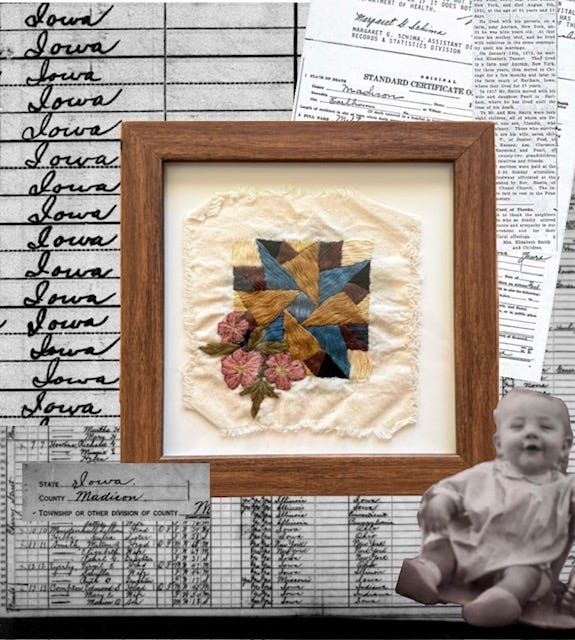
Isn’t all the best art inspired by taking pieces of the artist’s life & molding it into something more?
On the surface, this is a quilt block with a flower. But deeper, is a story of my family. Generations of men deep.
What I had thought was our family lineage was incorrect. With that, I realized that maybe I never even asked. You see, my dad’s dad was almost estranged. He was the definition of a small-town farmer. He only went into town once a month, and that was for groceries and a haircut.

A famous story in my family is the one about my dad joining the baseball team. With his parents’ approval, he joined the team but with a catch. He would have to walk the 7 miles into town for practice and then 7 miles back home. After early mornings working the farm, my dad would do just that.
This story comes to me often. I admire my dad. I understand my grandpa.
But, I still feel like my memories of him are a box with missing pieces.
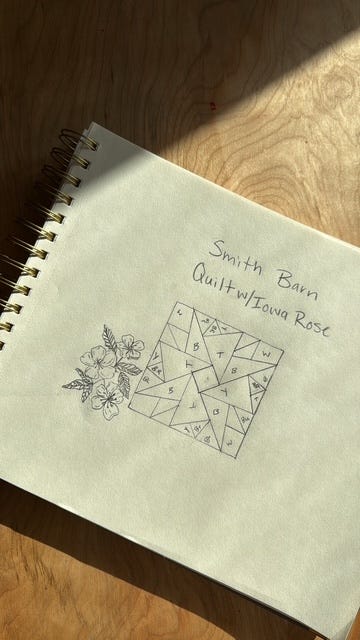
I had the idea of wanting to replicate a Barn Quilt he made for my dad. I felt like maybe, by putting this together, I could find some of those missing pieces.
During the time embroidering, I spent the majority of the time thinking of my grandpa and my dad. I then began thinking about who came before them and how much I don’t actually know.
I began pulling at strings and creating a vision of the males’ ancestry. (As it’s the easiest to track.) I made it all the way to the 1600s Germany. To Nicolaus Schmidt, who died in the Atlantic Ocean in 1706. His son, Johann, made it to America in 1723 and settled in New York State. Our name then changes to Smith. Within 2 generations, the Smiths are now Chicago residents. And then in one more generation, Iowans. My dad is now a 3rd generation Iowan.

I share because I wonder if my grandpa was also thinking about his ancestors when making his Barn Quilt.
Barn Quilts have roots in Germany. Early European immigrants (particularly German and Dutch) brought to the American colonies the practice of adorning barns with symbols for good luck or identification.1
I think under the hardships and estrangement, he was simply a father making a symbol of hope and luck for his firstborn son.
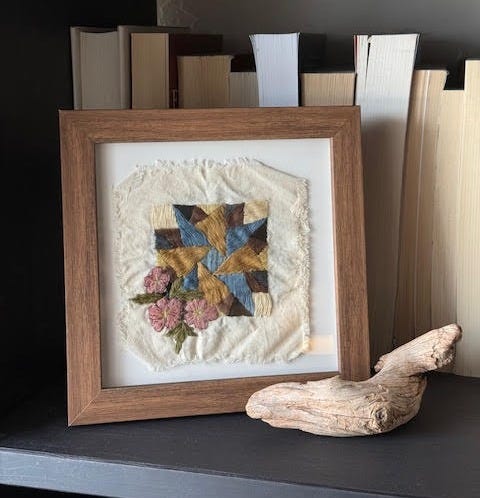
I’m proud to have a replica of it in my home now. I added the state flower, the Prairie Rose. Roses are my dad’s favorite, as they remind him of his mother. That detail makes it feel complete.
I look at this embroidery piece and I feel peace. I feel like I have shuffled around my box of missing pieces and found a few, tucked away.


Creating art that has story is what embroidery is all about. Women have traditionally been the visual story keepers and tellers of their families. Adding one into the collection fills me with pride.
Your support means the world to me. Thank you, thank you, thank you.
Until next time!

The History of the Barn Quilt: A Symbol of the American Midwest | Art & Object
Beautiful! There is something about ancestry and paying respect to it that we have somehow lost in our American culture and traditions. Learning about the past, no matter how uncomfortable it can be, really fills something inside ourselves and helps paint a greater picture of our family. Love it sis!
So lovely and interesting thank you for sharing :)